
Web Desk — December 6, 2025
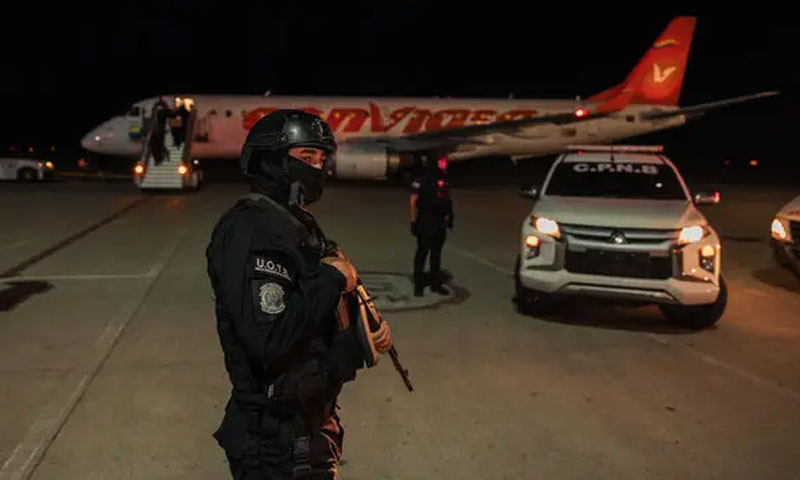
Caracas: A US deportation flight carrying 172 undocumented Venezuelan migrants landed in Caracas on Friday, marking the second such repatriation this week despite President Donald Trump’s recent declaration that Venezuelan airspace should be considered “closed in its entirety.” The aircraft departed from Phoenix, Arizona, carrying five children, 26 women, and 141 men, as confirmed by Venezuelan authorities.
Venezuela had suspended these flights earlier in response to Trump’s airspace order but reauthorized them on December 2 following a US request, highlighting a rare instance of cooperation amid escalating bilateral strains. Under the ongoing “Homeland Return” program, more than 18,260 Venezuelans have been repatriated since its launch, with over 14,000 sent back from the US alone.
The arrival coincides with unusual spikes in US military activity across the Caribbean, where the Trump administration has deployed significant forces—including the world’s largest aircraft carrier, the USS Gerald R. Ford—to counter alleged drug-trafficking networks linked to President Nicolás Maduro’s “leftist” regime. Over the past months, US forces have conducted more than 20 strikes on suspected smuggling vessels in the Caribbean and Pacific, resulting in at least 87 deaths, though no concrete evidence tying the operations to narcotics has been publicly disclosed.
Maduro has vehemently denounced these actions as a pretext for regime change and a bid to seize Venezuela’s vast oil reserves, vowing resistance from his 123,000-strong armed forces and 8 million reservists. In retaliation, Venezuela launched “Operation Sovereign Caribbean 200” military drills near La Orchila Island and mobilized nearly 200,000 troops along its coasts.
The US has positioned around 15,000 personnel in the region, including F-35 jets and MQ-9 drones in Puerto Rico, with documents indicating sustained troop presence through 2028. Analysts view the deportations as part of a broader pressure campaign, blending immigration enforcement with geopolitical maneuvering, though the airspace rhetoric—coupled with FAA warnings—has led to flight cancellations and heightened regional anxiety.
As tensions simmer, international observers urge de-escalation to avert a humanitarian crisis, with the UN High Commissioner for Refugees noting the perilous plight of Venezuelan migrants caught in the crossfire.