
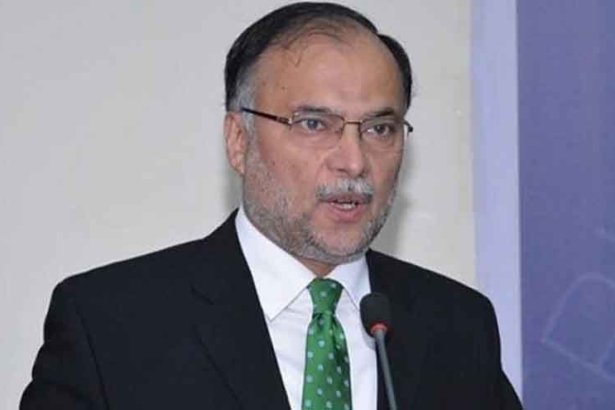
Beijing: Federal Minister for Planning Ahsan Iqbal has said that the China-Pakistan Economic Corridor (CPEC) is entering a new phase that will open doors of development and opportunities, especially for the younger generation of Pakistan.
Speaking at the opening session of the 14th Joint Cooperation Committee (JCC) meeting in Beijing, Iqbal described Pakistan and China as “iron brothers,” united by trust and a common future. He said Phase Two of CPEC will further boost progress after the achievements of the first phase.
During the Phase One, Pakistan added 8,000 megawatts of electricity to the national grid, built 888 kilometers of highways, and completed major projects in Gwadar, transforming it from a small fishing town into a key maritime hub. Work on upgrading the ML-1 railway line is also expected to modernize Pakistan’s rail network.
Ahsan Iqbal announced that 10,000 PhD scholarships and new innovation centers will be introduced for Pakistani students and researchers. He added that underdeveloped districts would benefit from reforms inspired by China’s poverty reduction model.
He revealed that proposals for export-focused Special Economic Zones (SEZs) in Karachi and Islamabad are under discussion, while new projects in agriculture, mining, border trade, and electric vehicles will also be part of CPEC’s second phase.
The minister also shared that a 300-megawatt solar power project in Gilgit-Baltistan will help reduce load-shedding, while Pakistan has set a target to produce 60% of its energy from clean sources by 2030.
You Might Also Like
UN security council may meet over India-Pakistan tensions
PM Shehbaz Sharif’s proficiency in Persian impresses Iranian delegation
If minor causes a traffic accident concerned SHO will be responsible: Court
Terrorists launch cross-border attack in Kurram; Two soldiers martyred, seven injured
Under the “Digital Silk Road” initiative, Pakistan will see the introduction of 5G technology, fiber optic networks, data centers, and joint research labs in artificial intelligence and quantum computing.
Assuring complete security for CPEC projects and Chinese personnel, Iqbal said the partnership will drive growth across five key areas: economic expansion, innovation, green energy, better livelihoods, and regional connectivity.
Moreover, Pakistan and China have agreed to bolster their strategic partnership, with a focus on deepening cooperation in industry, agriculture, and mining. The commitment was made during the sixth round of the Pakistan-China Strategic Dialogue, co-chaired by Pakistan’s Deputy Prime Minister Ishaq Dar and Chinese Foreign Minister Wang Yi in Islamabad on Thursday.
During a joint news conference, Chinese Foreign Minister Wang Yi expressed his country’s firm support for Pakistan’s economic resilience. He stated that the current priority for both nations is the “high-quality development of an upgraded version of CPEC” (China-Pakistan Economic Corridor). The focus will be on building upon past achievements and developing new corridors.
Yi announced that the two countries will continue to jointly support the development of Gwadar Port and will also promote the Karakoram Highway realignment project. He also welcomed the participation of third parties in the ML-1 project of Pakistan Railways, signaling an openness to broader international collaboration on key infrastructure.
On the humanitarian front, the Chinese Foreign Minister extended his sympathies over the recent devastating floods in Pakistan and pledged to provide immediate emergency assistance to the victims.
We welcome your contributions! Submit your blogs, opinion pieces, press releases, news story pitches, and news features to spotpakistan25@gmail.com